Let’s face it, Chemistry can be a pain. Named reactions, mechanisms, compounds, resonance, the periodic table... gah! But that doesn’t mean it can’t be fun. The world is filled with crazy crap to learn and laugh about.

Hey, I’m Amogh Sood and this is The Blank Notebook, the Chemistry blog for high school students by a high school student. Whenever that NCERT textbook seems too scary to look at, drop by and see what we’re talking about. Hopefully my homemade comic strips will keep you interested. Come for the laughs, stay for the learning.

Just remember: A Blank Notebook a day keeps blank answer sheets away!

Maintained by Amogh Sood (also know as the The Passive Observer). Plagiarism is not cool, please take due permission if you intend to use some of my work.

Friday, 8 March 2013

Atomic Structure: The Quantum Mechanical Model


The Story So Far: "Atomic Structure: The Story"


Basically we covered how several scientists tried (and failed) to come up with a satisfactory atomic model.

Then came along Schrodinger (you can learn more about him and his cat here and here and check out this minute-physics video here ), and he came up with this fancy equation we now know as "Schrodinger's Equation" (surprise, surprise!)

 It is a three dimensional, second differential, time- dependent equation. (Jargon..ignore this)

<DO NOT IGNORE ANY OF THIS>

For a system such as an atom or molecule whose energy does not change with time, Schrödinger’s equation can be written as,  E\Psi=\hat H \Psi 

Now this equation was solved to obtain quantum numbers (among other things....but we won't get into that right now). 

Quantum Numbers: Out of the 4 quantum numbers only the first 3 were obtained from Schrodinger's Equation and infact only the first three are needed to define an Orbital.

 n = principal Quantum Number. (Orbit)
 l = azimuthal Quantum Number. (Sub-shell)
m= magnetic Quantum Number. (Orbital)
m= spin Quantum Number.

An Orbital is the region in 3 dimension space where there is maximum probability of finding an electron (since we cannot ascertain for sure the exact position of an electron (refer: Hesienberg's Uncertainty and Dual Nature of Matter)

Quick Tip: Quantum numbers are like the address of an electron. Just like your address has a house number, a street name, a city name and an area code..quantum nos. are used to describe the orbit, subshell and orbital (i.e the region where you are likely to find an electron...his house that is).

But..eh Shit Happens. 


Principal Quantum Number (n)

The principal quantum number n describes the average distance of the orbital from the nucleus — and the energy of the electron in an atom. It can have positive integer (whole number) values: 1, 2, 3, 4, and so on. The larger the value of n, the higher the energy and the larger the orbital. 

The Angular Momentum Quantum Number (l)

The angular momentum quantum number l describes the shape of the sub-shell  

The angular momentum quantum number l can have positive integer values ranging from 0 to n–1. F

The value of l defines the shape of the orbital, and the value of n defines the size.


Ready Reference Chart #1

Value of l     Subshell

0                    s
1                    p

2                    d
3                    f
4                    g

Ready Reference Chart #2

Value of n       Value(s) of l                  Sub-shells

n=1;                 l=0                            1s
 n=2;                l=0, 1                        2s                2p
 n=3;                l=0, 1, 2                    3s                3p                3d
 n=4;                l=0, 1, 2                    4s                4p                 4d              4f


No. of subshells = n

The Magnetic Quantum Number (m)


This number tells us about the orientation of the orbitals in 3-dimensional space. 


 The values allowed are integers from –l to 0 to +l. 


For example, if the value of l = 1 (p orbital), you can write three values for this number: –1, 0, and +1. 

This means that the p subshell has 3 orbitals, each with the same energy but different orientation.
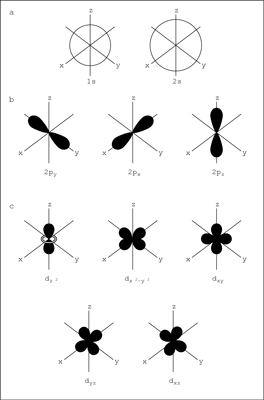

Shapes and Orientation of Various Orbitals

An orbital can accommodate maximum of 2 electrons with opposite spins. 


So if an orbital is thought of as a house, then no more than two people can live in that house and the two people live on different floors cause they can't stand each other.


Numbers of orbitals in any sub-shell = (2l+1)


The Spin Quantum Number (ms )


This describes the spin of an electron. 

The spin quantum number has 2 values +1/2 and -1/2

+1/2 = electron spins clockwise (spin up) and is indicated by an arrow pointing upwards (↑).
-1/2 = electron spins anticlockwise (spin down), indicated by arrow pointing downwards (↓).

[By convention when there is only electron, it is taken as  +1/2]


The Electron Balance Sheet


Numbers of sub-shells in any orbit = n

Numbers of orbitals in any sub-shell = (2l+1)

Max no. of e- in any orbital = 2

Max. no. of e- in any sub-shell = 2(2l+1)

No. of orbitals in any orbit = n2               
Max. No. of electron in any orbit =  2n2


Filling in Electrons

While filling in electrons we follow the following rules:

1. Pauli exclusion principle

No two electrons in an atom can have the same value for all the 4 quantum numbers. 

2.Hund’s rule of maximum multiplicity

Pairing of electrons in a sub-shell will not take place until all the orbitals are at least half filled. 

Half filled and fully filled orbitals have extra stability, because half filled and fully filled orbitals allow electrons to jump about and in doing so they expend energy (exchange energy) and lower energy equals greater stability.

3.Aufbau Principle

Electrons are filled in sub-shells in increasing order of energy.

For Hydrogen atom, the energy is given by the principle quantum no. n, whereas for other atoms, energy of subshell is given by (n+l) values. 

Orbitals with lower values of (n+l) have lower energy. If two sub-shells have the same value of (n+l), then the one with lower value n has lower energy.


Order of filling in subshells. superscript indicates max. no. of electrons that can be accommodated in a subshell


DIY: Write down the electronic configuration of the first 40 elements in the periodic table...do that and you'll get the hang of it. 

Be careful with chromium and copper.

Chromium expected electronic config. :  [Ar] 4s2 3d4

But remember Hund's rule (yes, the one from up there).."half filled orbitals have maximum stability.

So one of the s electrons is excited and sent to the d-orbital which now has 5 electrons (half filled, since the d-subshelll can accommodate a maximum of 10 electrons)

So Chromium's real electronic config. :  [Ar] 4s1 3d5

Same thing goes for copper. Copper's electronic configuration is :  [Ar] 4s1 3d10   (instead of [Ar] 4s2 3d9  )


Here's the first 20 to get you started.


TipNoble gases are like checkpoints. To abbreviate the electronic configuration of an element the electronic configuration of the preceding noble gas is taken out and put in brackets, since all but the last few subshells of any element are identical to those of the noble gase, and the outer electronic configuration of the element is put down.

Therefore, Sodium's electronic configuration can be written as [Ne]3s1


Electronic Configuration of Ions

For cations, remove electrons from the outermost shell irrespective of the order in which the shell was filled. 
The number of electrons removed is equal to the charge on the cation.

For anions, add electrons equal to the charge on the anion.


_________________________

That's all Folks!!

The Passive Observer Out!


Wednesday, 6 March 2013

Atomic Structure: The Story


Disclaimer: This post reads like a story...nothing heavy here. Sit back and relax.


The idea of  "atoms" as fundamental, indivisible particle of nature is Old..very old...Think ancient greece and ancient India....yup that old. In fact the word "atom" comes from the ancient Greek adjective atomos, meaning 'indivisible'. 


John Dalton was one of the first people to propose that atoms are responsible for chemical interactions and he put for the following postulates in atomic theory


  1. Elements are made of extremely small particles called atoms.
  2. Atoms of a given element are identical in size, mass, and other properties; atoms of different elements differ in size, mass, and other properties.
  3. Atoms cannot be subdivided, created, or destroyed.
  4. Atoms of different elements combine in simple whole-number ratios to form chemical compounds.
  5. In chemical reactions, atoms are combined, separated, or rearranged.


And he had it right, for the most part at least.

Discovery of Sub-atomic Particles

Enter Sub-atomic particles. Now these buggers shook up the scientific community..

Cathode Rays and The Discovery Of Electrons 

Now atoms were thought of as indivisible particles untill the JJ Thomson discovered the electron. He did so by studying cathode rays in a Crookes tube. Now a Crookes tube is an evacuated glass tube with electrodes on either end and a coating on phosphorescent material on one side. Now, when a voltage was applied across the electrodes the phosphorescent material began to glow and Thomson concluded that this glow was due to certain rays originating at the cathode and thus he called them cathode rays (GENIUS!!).

Now on further experimentation, the following characteristics of cathode rays were observed.

Characteristics of cathode rays

1) Cathode rays originate at the cathode and consist of a stream of negatively charged particles.
2) Cathode rays travel in straight lines (they cast shadows of objects placed in their path).
3) Cathode rays possess high energy.
4) The e/m(specific charge) ratio of cathode rays remained constant.
5) The rays are deflected by an electromagnetic field.

Charge of an  =1.6×10⁻¹⁹ C (calculated by milikan)
Mass of an  =9.1×10⁻³¹ kg
 e/m ratio 1.758×10¹¹ C/kg

Anode (Canal) Rays  & The Discovery of Protons

Canal (Anode) rays were called so as they originated in the region between the anode and cathode.
(Thank you Mr. Point Out the Obvious...these physicists could've made use of some imagination when they came up with these names).

 They consisted of positively charged ions and moved towards the negatively charged cathode. They were produced as a result of the interaction between cathode rays and gaseous atoms. During such interactions, the energy of the cathode rays was imparted to the gaseous atom resulting in knocking out of one or more electrons from the gaseous atom. This process lead to the formation of positively charged ions and these positively charged ions constituted the anode rays. Unlike cathode rays the e/m ratio of anode rays did not remain a constant and varied with the gas that was taken in the tube.

 When Hydrogen gas was taken inside the tube and a voltage was applied, the hydrogen molecule split into hydrogen atoms which then interacted with the cathode rays and lost their lone electron it. The particle thus obtained was the "Proton". 

Tidbits: The mass of proton is approx 1837 times that of an electron. Protons were discovered by Goldstein.


Discovery of Neutrons

A thin strip of beryllium was bombarded with α-particles and it was found that new rays were coming out which consisted of particles having unit mass but no charge. The particles were named "neutrons" and James Chadwick was responsible for this discovery. Protons and neutrons together are collectively known as nucleons


 So now that we have all the fundamental particles on hand, let's start putting together "The Atom"

Now the first atomic model was given by Thomson and was called the "Plum Pudding Model" (finally!!).

So anyway, the electrons in this model were embedded in a sphere of positive charge, kinda like raisins in a pudding and hence the name. Unfortunately, this model of the atom was inconsistent with later experimental observations.

<Sorry JJ, you did good though, that's why they gave you the Nobel prize....don't worry, it's okay to be wrong>


Rutherford's Scattering Experiment and Rutherford's Model: 


Rutherford bombarded a gold foil with alpha particles ( He 2+ ions) and placed a fluorescent screen of zinc sulphide behind the foil, which produced a tiny flash of light whenever it was hit by an alpha particle.


He then made the following observations:


1) Most of the alpha particles passed through the foil undeflected.

2) A small fraction of them were deflected by small angles. A few, however bounced back.

This forced Rutherford to conclude that "The Atom" was mostly empty space, Yes, empty space as most of the alpha particles passed without any deflection, and that there was a region of concentrated positive charge within the atom. These results were inconsistent with Thomson's model which suggested that the mass of the atom was uniformly distributed.


Rutherford's model of the atom was akin to a solar system, where the nucleus i.e region of positive charge was positioned at the center and the electrons moved around it in orbit.

Well, he was wrong too. Now, basic physics, a body moving in a circular orbit undergoes acceleration even if it is moving with a constant velocity. And, according to Maxwell's electromagnetic theory a charged body (like an electron) when accelerated would emit radiation. Thus an electron in orbit will release energy and its orbit will continue to shrink untill it spirals into the nucleus and the atom collapses. (which would take approximately 10^-8 seconds...and that is not a lot of time..so, yeah thank god rutherford got it wrong).


Quick Tip: Picture a child made to run around a tree, initially he is full of energy and runs large circles but after a while as he gets tired (i.e looses some of his energy) he starts running smaller and smaller and smaller circles and eventually, well, he collapses.


(No children were harmed in the making of this post.)


The next Big Thing was the BOHR MODEL. But we'll get to that in a minute...maybe more than a minute, but background is important people.


So Buildup to the Bohr Model:


A Particle or a Wave...?


Wave Nature:


James Maxwell suggested that when electrically charged particles move under acceleration, alternating electrical and magnetic fields are produced and these fields are transmitted as electromagnetic waves/radiation. He also made the connection that light waves were also associated with these electromagnetic oscillations.


c=vλ , where c is speed of electromagnetic radiation (all em radiations travel at a constant speed of 3.0 x 10^8 m/s in vacuum) v is frequency and λ the wavelength.


Particle Nature:


Now, this guy called Planck comes around and says that all atoms can emit(or absorb) energy in discrete packets called quantum i.e atoms don't emit or absorb energy in a continuous manner. He also gave the following relation:


E=hv, where E is energy emitted/absorbed, h is planck's constant and v is frequency of electromagnetic radiation.


The particle nature could explain phenomenon like black-body radiation and photoelectric effect satisfactorily, however was inconsistent with the known wave behavior of light. 

So the scientists had no choice but to accept the fact that light has both wave and particle like characteristics.


[A few key topics like the photoelectric effect, spectra and line spectrum of hydrogen and Rydberg's formula have been omitted in this post. I promise I will cover them later, but I advise you to look them up yourself.]


Bohr Model:


Bohr put forth the following Postulates:


1) An Atom consists of central positive part called nucleus around which the electrons are revolving in selected circular orbits .These orbits are associated with definite energies and are also called energy shells or energy levels. 


2)As long as the electron is in the orbit, its energy does not change with time.i.e. energy of an electron in a particular orbit remains constant. This is why these orbits are also called stationary states.


3)Electrons can occupy only those orbits where the angular momentum is an integral multiple of  .

    
i.e mvr= n.(h/2π)   where n=1,2,3,…..

Thus, Bohr quantized angular momentum.


4)Electrons can move only from one orbit (energy level) to another. 

     
 (Bohr frequency rule)  ∆E= E2-E1 = hv 

When electrons move a characteristic amount of energy is absorbed (when electrons move from lower to higher level) or emitted (when electrons move from higher to lower level). Since each orbit has a characteristic energy, emission and absorption of energy occur only in discrete values (equal to difference in two energy levels) and will correspond to a characteristic frequency and wavelength. Energy change is not gradual or continuous but is abrupt and this explains the fact that atomic spectra are discontinuous.


E2=energy of higher level  


E1=energy of lower level.

Bohr gave useful relationships for calculating the energy and radius of electron in an orbit.


As Z increases energy value becomes more –ve and radius decreases i.e.electrons will be held tightly to the nucleus

As n increases, r will increase i.e. the electron will be present away from nucleus).
Velocity of electron in orbit increases with increase in positive charge on nucleus and decreases with increase in the value of n. 


Advantage of Bohr’s model of atom


1)Bohr’s model of atom imparted certain degree of stability to the model of atom.
2)It was the first model of atom which incorporated the principles of quantum mechanics (Bohr quantized angular momentum and energy.)
3)Bohr’s model of atom was able to explain the spectra of hydrogen and H-like ions (hydrogenic ions) i.e. simple spectra.
4)Bohr’s model of atom gave certain useful relationship to calculate the energy of electron, radius of orbit etc.

Disadvantage of the Bohr’s model of atom

1)Bohr’s model of atom was two dimensional.
2)Bohr’s model was able to explain simple spectra but failed to explain complex spectra.
3)Bohr’s model of atom failed to explain Zeeman effect and Stark effect.
4)Bohr’s model of atom went against de Broglie relationship and Heisenberg’s uncertainty principle.
5)Bohr’s model could not explain bonding of atoms, or how molecules are formed from atoms and shapes of molecules.

(*Zeeman Effect-splitting of spectral lines in the presence of a magnetic field.
*Stark-Effect-splitting of spectral lines in the presence of an electric field) 

Towards the Quantum Mechanical Model (but not quite there yet...)


Seriously..make up your mind!


Now I am no expert, but quantum mechanics is brilliant and crazy shit, at the same time. Quantum mechanics answers a dozen question and raises a dozen questions, at once. Get it?

Quantum mechanics is where science transitioned from certainty to uncertainty. It told us that nothing can be known for sure and trying is simply a waste of time, everything exists everywhere and nothing exists anywhere at the same time.

Now the last two topics for this particular post:

de Broglie Relationship

Well take Plank's E= hv = hc/λ and equate it with Einstein's E=mc^2

λ= h/(mv) (de broglie relationship)

WhatTheFact....Now de broglie proposed that matter, like electromagnetic radiation, had both wave like and particle like characteristics, which is apparent from the relationship described above.

But, the wave nature of matter as you can see in the above relation, is inversely proportional to the mass.

So for macroscopic bodies like humans (or cats) our wave nature is negligible but for a tiny little thing, say an electron, displays significant wave character.

In fact, it has been proven experimentally that an electron beam undergoes diffraction, a characteristic phenomenon associated with waves. This fact has been put to use in the making of an electron microscope.

Heisenberg's Uncertainty Principle

Now Werner Heisenberg in 1927, comes around and says "It is impossible to determine simultaneously the exact position and exact momentum (or velocity) of an electron."

Now, How...?

Quick Tip: If I hand you a rectangular block and ask you to measure its dimensions, what would you use? a ruler, obviously. But what if I scale down and hand you a coin and ask you to measure its thickness, what would you use? You can't use a ruler, instead you will need an instrument graduated in units smaller than the thickness of the coin, like a vernier scale or a micrometer.

Similarly, in order to determine the position of an electron, we must use an instrument calibrate in units smaller than the dimensions of the electron (bear in mind that an electron is a point charge and essentially dimensionless..still play along) So to observe an electron we will "illuminate" it with light of a short wavelength (i.e wavelength smaller than the dimensions of the electron) but such radiation would posses a great amount of energy and this energy would be transferred to the electron, thus effecting a change in its velocity.

So we have been accurately determined the position of the electron but in doing so we have changed its velocity. If we use a light of longer wavelength then we can avoid the error in measuring its velocity but then we cannot accurately estimate its position.

Mathematically, the uncertainty can be given by the following equation:

Δx.Δp >/=  h/4π, where Δx is the uncertainty in position, Δp is uncertainty in momentum and h is planc's constant.

or Δx.Δv >/= h/4πm, where m is mass and Δv is the uncertainty in position.

_____________________

That's all folks!

Stay tuned for a part 2, in which I will deal with the quantum mechanical model of the atom, but here's the story thus far.

Cheers!

The Passive Observer Out


Tuesday, 5 March 2013

Types of Bonds

A bond, as its names suggests, holds atoms together to form molecules.

In this article we study a few elementary types of bonds.


Ionic Bond

An ionic bond is formed as consequence of the electrostatic forces of attraction between oppositely charged ions. 

If the difference in electronegativity of the atoms is over 1.7 the bond is likely to be ionic.


Covalent Bond

A covalent bond is formed due to the sharing of valence electrons or in terms of the orbital concept, a covalent bond is formed due to the overlapping of atomic orbitals. 

If the difference in electronegativity of the atoms is less than 1.7 the bond is likely to be covalent. 

In practice most bonds are not 100% covalent or ionic.

If the difference in electronegativity between the 2 bonded atoms is zero, then the bond is purely covalent. If the difference in electronegativity between the 2 bonded atoms ranges from zero to 1.7 the bond is a polar covalent bond and exhibits some ionic character. If the difference in electronegativity between the 2 bonded atoms is 1.7 then the bond is 50% covalent and 50% ionic and if the difference in electronegativity is over 1.7 then the bond is said to be ionic.

Ready-Reference Chart (ΔE is the difference in electronegativity)

ΔE Value             Bond Character 

ΔE = 0;                 100% Covalent
ΔE =  0-1.7;          polar covalent
ΔE = 1.7;              50% covalent 50% ionic
ΔE > 1.7;              ionic

Dipole Moment: Accounts for the ionic character of covalent bonds.

Homo-nuclear, diatomic molecules (eg. H2  ,  Cl2 etc.) are non-polar.

In case of hetero-nuclear molecules, for a molecule to be non polar, the central atom mustn't have a lone pair of electrons and the central atom must be surrounded by the same atoms i.e the molecule must be symmetrical (explained below). (both conditions must be met).

However, if these conditions aren't met, then the more electronegative element will pull the electrons towards itself and thus acquire a slightly negative charge (given as  δ- ) and the other atom shall acquire a slight positive charge (given as  δ+ ).

Quick Tip: Think of the bond as a match of tug of war, the stronger (in this case more electronegative element) player will pull the rope (in this case electrons) towards himself.


Such a bond is termed a polar covalent bond and its polarity is given in terms of dipole moment. 

Dipole moment (m) = electric charge x distance of charge seperation (bond length)
m = q x d
Dipole moment is measured in ‘Debye’ unit (D)


Dipole moment is a vector quantity, therefore if a molecule with polar bonds is symmetrical then the opposite pulls will cancel each other resulting in zero net dipole. eg. Carbon dioxide, pictured below.


Fajans' Rules: Account for the covalent nature of ionic bonds. According to these small cations (or high positive charge) have greater polarising power and large anions have greater polarisibility, thus bonds formed between such species involves overlap of their electron clouds resulting in covalent character.

Quick Tip: Picture a large bunch of teenage girls (electrons) on a field trip with their teacher (nucleus) and let's call this group our anion. Now a small cation, hmm Justin Beiber for instance, walks in, and some of the girls move away from the group towards him. Thus the small cation, Justin Bieber in this case has pulled the electron cloud of the large anion towards himself and this mingling of electron clouds accounts for the covalent character of the bond.

If the group were smaller (i.e the anion was smaller) the teacher would've been able to check the movement of the girls. And  if the celebrity was somebody more important (i.e a larger cation), like Kazimierz Fajans(yes, he is the guy behind fajans rule) for instance, again fewer girls (electrons) would've strayed away from the group.


Ready-Reference Chart

Ionic                               Covalent

Low +ve charge              High +ve charge
small anion                      large anion
large cation                     small cation 


Metallic Bonding

Since Ionic and Covalent bonds cannot account for many physical properties of metals, such as strength, malleability, ductility, thermal and electrical conductivity, opacity, and luster, the concept of metallic bonding has been devised.

The positive charge in a metal aggregates to form a "kernel" whereas the electron separate out forming an electron cloud.

Metallic bonding constitutes the electrostatic attractive forces between these delocalized electrons, gathered in an electron cloud, and the kernel of positively charged metal ions.


Shitty illustration depicting kernel of positive charge and cloud of electrons.


________________________


That's all folks!

The Passive Observer


Monday, 4 March 2013

What is an Acid?


The Arrhenius Definition

Svant Arrhenius
According to Arrhenius (pictured left) an acid disassociates in an aqueous solution to give H3O+ ions (Hydronium ion, which is a protonated water molecule as a bare proton H+ cannot exist in aqueous solution as a free species).


An Arrhenius base on the other hand disassociates in aqueous solution to give OH- ions

According to this definition:

Acids                                    Bases

H2SO4 ,                               NaOH
HCl ,
HNO3 etc                                      Ca(OH)2 etc


Credits: Z(J)ubin
What The Fact... Most students, thus tend to believe that bases contain an OH group, but they fail to realize that some acids too have an OH group attached to them, but still disassociate to give H+ (or H3O+ ions).  eg H2SO4

Well this anomaly of sorts can be explained on the basis of difference in electronegativity.


In case of the H2SO4   molecule, the difference in electronegativity between Oxygen and Hydrogen is greater than the difference in electronegativtiy between Oxygen and Sulfur. Therefore the bond between Oxygen and Hydrogen polarizes giving HSO4-  and H+   Refer to structure pictured below.


In case of a base (NaOH) the difference in electronegativity between Sodium and Oxygen is greater than the difference in electronegativity between Hydrogen and Oxygen, thus the bond between Oxygen and Sodium polarizes giving Na+   and OH-  Refer to structure pictured below.


<Tip: Think of a bond as a match of tugowar in which the more electronegative element will pull the electrons towards itself>

Drawbacks: This theory fails to account for the acidic behavior of compounds like BCl3 and basic nature of compounds like NH3.


Brønsted–Lowry Definition

Brønsted and Lowry defined an acid as a proton donor and a base as a proton acceptor.

The removal of a proton (hydrogen ion) from an acid gives its conjugate base, and the addition of a proton to a base produces its conjugate acid. 

For instance:

  • HCl + H2 is in equilibrium with Cl- + H3O+            


Conjugate acid:  H3O+
Conjugate base: Cl

  • NH3 + H2 is in equilibrium with  OH- + NH4+


Conjugate acid:  OH-
Conjugate base: NH4+


Note: Weak acids give strong conjugate bases and weak bases give strong conjugate acids. Whereas strong acids give weak conjugate bases and strong bases give weak conjugate acids.


Water being amphoteric acts as both acid and a base. For instance in the reaction with Hydrochloric acid, water acts as a base but in the reaction with Ammonia water acts as an acid.

H2O + H2O is in equilibrium with H3O+ + OH


Lewis Definition

Gilbert N Lewis removed the hydrogen (or proton requirement) of the Arrhenius concept and Bronsted-Lowry Definition and instead based his definition on electron pairs.

Lewis acids thus are compounds that are electron deficient and thus can accept a lone pair of electrons 
eg: BCl3 

In BCl3  Boron is sp2 hybridised and it is made apparent from the diagram pictured below it has a vacant p-orbital and is thus electron deficient.


Relation between alkalis and bases
And Lewis base is a compound that can donate a lone pair of electron 

eg. NH3


Note: On an unrelated note, a lot of people tend to use the terms alkali and base interchangeably, this however is incorrect. All alkalis are bases, but only water soluble bases are alkalis. 


______________________

That's all folks.

The Passive Observer Out!