The Story So Far: "Atomic Structure: The Story"

Basically we covered how several scientists tried (and failed) to come up with a satisfactory atomic model.
Then came along Schrodinger (you can learn more about him and his cat here and here and check out this minute-physics video here ), and he came up with this fancy equation we now know as "Schrodinger's Equation" (surprise, surprise!)
It is a three dimensional, second differential, time- dependent equation. (Jargon..ignore this)
<DO NOT IGNORE ANY OF THIS>
For a system such as an atom or molecule whose energy does not change with time, Schrödinger’s equation can be written as, 
Now this equation was solved to obtain quantum numbers (among other things....but we won't get into that right now).
Quantum Numbers: Out of the 4 quantum numbers only the first 3 were obtained from Schrodinger's Equation and infact only the first three are needed to define an Orbital.
n = principal Quantum Number. (Orbit)
l = azimuthal Quantum Number. (Sub-shell)
ml = magnetic Quantum Number. (Orbital)
ms = spin Quantum Number.
An Orbital is the region in 3 dimension space where there is maximum probability of finding an electron (since we cannot ascertain for sure the exact position of an electron (refer: Hesienberg's Uncertainty and Dual Nature of Matter)
Quick Tip: Quantum numbers are like the address of an electron. Just like your address has a house number, a street name, a city name and an area code..quantum nos. are used to describe the orbit, subshell and orbital (i.e the region where you are likely to find an electron...his house that is).
 |
| But..eh Shit Happens. |
Principal Quantum Number (n)
The principal quantum number n describes the average distance of the orbital from the nucleus — and the energy of the electron in an atom. It can have positive integer (whole number) values: 1, 2, 3, 4, and so on. The larger the value of n, the higher the energy and the larger the orbital.
The Angular Momentum Quantum Number (l)
The angular momentum quantum number l describes the shape of the sub-shell
The angular momentum quantum number l can have positive integer values ranging from 0 to n–1. F
The value of l defines the shape of the orbital, and the value of n defines the size.
Ready Reference Chart #1
Value of l Subshell
0 s
1 p
2 d
3 f
4 g
Ready Reference Chart #2
Value of n Value(s) of l Sub-shells
n=1; l=0 1s
n=2; l=0, 1 2s 2p
n=3; l=0, 1, 2 3s 3p 3d
n=4; l=0, 1, 2 4s 4p 4d 4f
No. of subshells = n
The Magnetic Quantum Number (ml )
This number tells us about the orientation of the orbitals in 3-dimensional space.
The values allowed are integers from –l to 0 to +l.
For example, if the value of l = 1 (p orbital), you can write three values for this number: –1, 0, and +1.
This means that the p subshell has 3 orbitals, each with the same energy but different orientation.
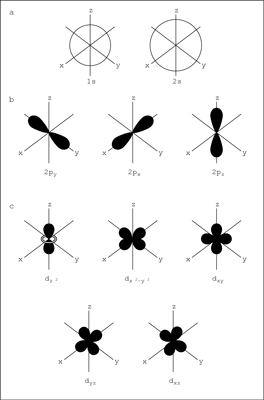 |
| Shapes and Orientation of Various Orbitals |
An orbital can accommodate maximum of 2 electrons with opposite spins.
So if an orbital is thought of as a house, then no more than two people can live in that house and the two people live on different floors cause they can't stand each other.
Numbers of orbitals in any sub-shell = (2l+1)
The Spin Quantum Number (ms )
This describes the spin of an electron.
The spin quantum number has 2 values +1/2 and -1/2
[By convention when there is
only electron, it is taken as +1/2]
The Electron Balance Sheet
Numbers of sub-shells in any orbit = n
Numbers of orbitals in any sub-shell = (2l+1)
Max no. of e- in any orbital = 2
Max. no. of e- in any sub-shell = 2(2l+1)
No. of orbitals in any orbit = n2
Max. No. of electron in any orbit = 2n2
Filling in Electrons
While filling in electrons we follow the following rules:
1. Pauli exclusion principle
No two electrons in an atom can
have the same value for all the 4 quantum numbers.
2.Hund’s rule of maximum multiplicity
Pairing of electrons in a sub-shell will not take place until all the orbitals are at least half filled.
Half filled and fully filled orbitals have extra stability, because half filled and fully filled orbitals allow electrons to jump about and in doing so they expend energy (exchange energy) and lower energy equals greater stability.
3.Aufbau Principle
Electrons are filled in sub-shells
in increasing order of energy.
For Hydrogen atom, the energy is
given by the principle quantum no. n, whereas for other
atoms, energy of subshell is given by (n+l) values.
Orbitals with lower values of (n+l) have lower
energy. If two sub-shells have the same value of (n+l), then the one with lower value n has lower energy.
 |
| Order of filling in subshells. superscript indicates max. no. of electrons that can be accommodated in a subshell |
DIY: Write down the electronic configuration of the first 40 elements in the periodic table...do that and you'll get the hang of it.
Be careful with chromium and copper.
But remember Hund's rule (yes, the one from up there).."half filled orbitals have maximum stability.
So Chromium's real electronic config. : [Ar] 4s1 3d5
Same thing goes for copper. Copper's electronic configuration is : [Ar] 4s1 3d10 (instead of [Ar] 4s2 3d9 )
Here's the first 20 to get you started.

Tip: Noble gases are like checkpoints. To abbreviate the electronic configuration of an element the electronic configuration of the preceding noble gas is taken out and put in brackets, since all but the last few subshells of any element are identical to those of the noble gase, and the outer electronic configuration of the element is put down.
Therefore, Sodium's electronic configuration can be written as [Ne]3s1
Electronic Configuration of Ions
For cations, remove electrons from the outermost shell irrespective of the order in which the shell was filled.
The number of electrons removed is equal to the charge on the cation.
For anions, add electrons equal to the charge on the anion.
_________________________
That's all Folks!!
The Passive Observer Out!
The Passive Observer Out!

This blog is really helpful to deliver updated educational affairs over internet which is really appraisable. I found one successful example of this truth through this blog. I am going to use such information now.FORTIGATE 50E
ReplyDelete