Before we get started on this day's lesson, it would greatly benefit you if you re-read these posts:
Types of Bonds
Atomic Structure (electronic configurations in particular)
Done that? Good.
Let's go over some important terms:
Now if you recall, covalent bonds are formed due to the overlapping of atomic orbitals containing unpaired electrons with opposite spins. Such an orbitals are referred to as bond pairs, i.e they can participate in bonding.
An orbital which cannot participate in bonding, i.e one with paired electrons is called a lone pair.
Now, it is only logical that the strength of a bond directly correlates to the extent of overlapping. Greater the overlapping, stronger is the bond.
Orbitals can overlap in 2 ways:
(i) axial overlapping (along the axis): this results in the formation of a sigma(σ) bond.
(ii) sideways overlapping: results in the formation of a pi (π) bond. A pi bond is representative of a diffused electron cloud above and below the sigma bond that is shared by the two bonded atoms.
Note: That only one sigma bond can be formed between two atoms. The first bond formed is always a sigma bond.
a) Single Bond (eg. C-C): 1σ bond
b) Double Bond (eg. C=C ): 1σ + 1π bond
c) Triple Bond (eg. C≡C): 1σ + 2π bond
Bond Length: Is the average distance between the nuclei of two bonded atoms.
Study the energy diagram given below to better understand this phenomenon.
Quick Tip: Bear in mind that when two atoms approach one another, there are attractive (between electrons and nucleus) and repulsive (inter-electronic and inter-nuclear) forces at play. Initially the atoms move closer under the influence of attractive forces and as they move closer their potential energy decreases (generally, energy is released during bond formation). They reach a certain minimum distance at which attractive and repulsive forces are evenly matched. If the atoms move any closer, repulsive forces will dominate and cause the energy diagram to spike (as can be seen on the left). Since lower energy states are preferred by all systems, atoms are thus held a certain distance apart, where the the attractive and repulsive forces are evenly balanced and energy level is minimum. This minimum distance is called the bond length.
Remember: Bond Strength ∝ Bond Order ∝ 1/Bond length
Bond Angle: Angle Subtended by the bonded molecules.
Bond Disassociation Energy: Energy required to break a certain bond and take the bonded atoms to their gaseous states.
Okay, let us consider the water molecule. If we were to remove the Hydrogen on the right, we would need to expend a certain amount of energy, says, BE-1. Now, it is only natural that the oxygen atom bereft of a hydrogen atom would hold on more dearly to the second hydrogen on the left. So now if we were to remove the second hydrogen we would have to supply a slightly greater amount of energy (BE-2)
BE-2 > BE-1
So for the sake of convenience, we take the average of the two Bond Disassociation Energies and call it Bond Energy.
Bond Energy (O-H) = (BE-1+BE-2)/2
That pretty much covers all you need to know to follow whatever comes next.
Hybridization <This Shit IS IMPORTANT>
Central Atom: atom forming the maximum no. of bonds.
Orbitals of the central undergo hybridization ( in layperson language, it refers to the mixing of atomic orbitals) to form hybrid orbitals which overlap with "normal" orbitals of neighboring atoms to form bonds.
Conditions: i) Orbitals should have the same or almost the same energy.
ii) Hybrid orbitals formed should also have similar energy levels.
iii) Number of orbitals remains the same.
iv) Both bond pairs and lone pairs can take part in hybridization.
Types of Hybridization
sp hybridization: forms 2 sp hybrids, each with 50% s and 50% p character.
sp2 hybridization: forms 3 hybrid orbitals, each with 33.33% s and 66.66% p character.
sp3 hybridization: forms 4 orbitals each with 25% s character and 75% p character.
sp3 d hybridization: 5 orbitals with, 20% s, 60%p and 20% d character.
Sp3d2 hybridization: 6 orbitals with 16.66% s, 50% p and 33.33% d character.
(in case you haven't already noticed, the letters (s,p,d etc.) indicate the orbitals participating in hybridization.)
Formation of Hybrid Orbitals
SP hybridization
 in BeCl2 Beryllium is sp hybridized.

 Carbon in CCl4 is sp3 hybridized.
The process is pretty much the same.
C in ground state: 2s2 2p2
C in the excited state: 2s1 2p3
Four hybrid orbitals are thus formed, with an unpaired electron in each. These then overlap with the Chlorine p-orbital with a bond pair.

P in the ground state: 3s2 3p3 3d0
P in the excited state: 3s1 3p3 3d1
Five hybrid orbitals are formed, with an unpaired electrons in each. Each of these then overlap with the Chlorine p-orbital with a bond pair (i.e unpaired electron). Note: that the axial chlorine atoms project out of the plane of the molecule.

S in the ground state: 3s2 3p4 3d0

I in the ground state: 5s2 5p5 5d0
I in the excited state: 5s1 5p3 5d3
Types of Bonds
Atomic Structure (electronic configurations in particular)
Done that? Good.
Let's go over some important terms:
Now if you recall, covalent bonds are formed due to the overlapping of atomic orbitals containing unpaired electrons with opposite spins. Such an orbitals are referred to as bond pairs, i.e they can participate in bonding.
An orbital which cannot participate in bonding, i.e one with paired electrons is called a lone pair.
Now, it is only logical that the strength of a bond directly correlates to the extent of overlapping. Greater the overlapping, stronger is the bond.
Orbitals can overlap in 2 ways:
(i) axial overlapping (along the axis): this results in the formation of a sigma(σ) bond.
(ii) sideways overlapping: results in the formation of a pi (π) bond. A pi bond is representative of a diffused electron cloud above and below the sigma bond that is shared by the two bonded atoms.
Note: That only one sigma bond can be formed between two atoms. The first bond formed is always a sigma bond.
Bond order: the no. of bonds present between atoms in a molecule.
a) Single Bond (eg. C-C): 1σ bond
b) Double Bond (eg. C=C ): 1σ + 1π bond
c) Triple Bond (eg. C≡C): 1σ + 2π bond
Bond Length: Is the average distance between the nuclei of two bonded atoms.
Study the energy diagram given below to better understand this phenomenon.
 |
| H2 Bond length |
Quick Tip: Bear in mind that when two atoms approach one another, there are attractive (between electrons and nucleus) and repulsive (inter-electronic and inter-nuclear) forces at play. Initially the atoms move closer under the influence of attractive forces and as they move closer their potential energy decreases (generally, energy is released during bond formation). They reach a certain minimum distance at which attractive and repulsive forces are evenly matched. If the atoms move any closer, repulsive forces will dominate and cause the energy diagram to spike (as can be seen on the left). Since lower energy states are preferred by all systems, atoms are thus held a certain distance apart, where the the attractive and repulsive forces are evenly balanced and energy level is minimum. This minimum distance is called the bond length.
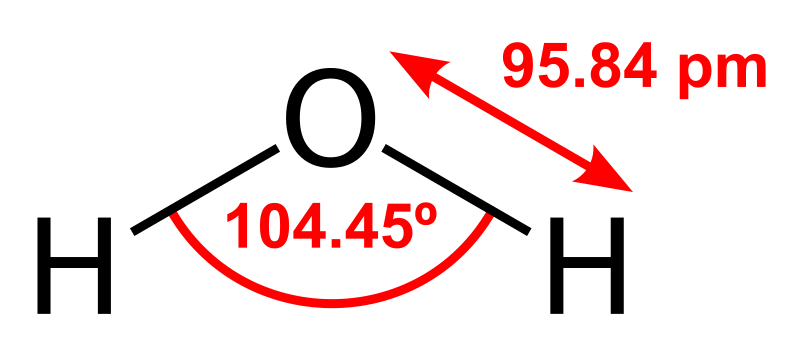 |
| Bond Angle In water molecule |
Remember: Bond Strength ∝ Bond Order ∝ 1/Bond length
Bond Angle: Angle Subtended by the bonded molecules.
Bond Disassociation Energy: Energy required to break a certain bond and take the bonded atoms to their gaseous states.
Okay, let us consider the water molecule. If we were to remove the Hydrogen on the right, we would need to expend a certain amount of energy, says, BE-1. Now, it is only natural that the oxygen atom bereft of a hydrogen atom would hold on more dearly to the second hydrogen on the left. So now if we were to remove the second hydrogen we would have to supply a slightly greater amount of energy (BE-2)
BE-2 > BE-1
So for the sake of convenience, we take the average of the two Bond Disassociation Energies and call it Bond Energy.
Bond Energy (O-H) = (BE-1+BE-2)/2
That pretty much covers all you need to know to follow whatever comes next.
Hybridization <This Shit IS IMPORTANT>
Central Atom: atom forming the maximum no. of bonds.
Orbitals of the central undergo hybridization ( in layperson language, it refers to the mixing of atomic orbitals) to form hybrid orbitals which overlap with "normal" orbitals of neighboring atoms to form bonds.
Conditions: i) Orbitals should have the same or almost the same energy.
ii) Hybrid orbitals formed should also have similar energy levels.
iii) Number of orbitals remains the same.
iv) Both bond pairs and lone pairs can take part in hybridization.
Types of Hybridization
sp hybridization: forms 2 sp hybrids, each with 50% s and 50% p character.
sp2 hybridization: forms 3 hybrid orbitals, each with 33.33% s and 66.66% p character.
sp3 hybridization: forms 4 orbitals each with 25% s character and 75% p character.
sp3 d hybridization: 5 orbitals with, 20% s, 60%p and 20% d character.
Sp3d2 hybridization: 6 orbitals with 16.66% s, 50% p and 33.33% d character.
(in case you haven't already noticed, the letters (s,p,d etc.) indicate the orbitals participating in hybridization.)
Formation of Hybrid Orbitals
SP hybridization
in BeCl2 Beryllium is sp hybridized.
Be in ground state: 2s2
One of the 's' electrons is excited and moves to the p orbital
Be excited state: 2s1 2p1
Now, the s and the p orbitals undergo hybridization to form two sp-orbitals, with an unpaired electron in each.
Consider Chlorine. The chlorine atom is in the ground state and has the electronic configuration: 3s2 3p5
It is evident that the chlorine atom has an unpaired electron in a p-orbital.
Now, the sp-hybridized berylium atom overlaps with two chlorine atoms forming the compound BeCl2
Sp2 hybridization
in BCl3 Boron is sp2 hybridized.
B in the ground state: 2s2 2p1
One of the 's' electrons is excited and moves to the p orbital.
B in the excited state is now: 2s1 2p2
Now, the s and the 2 p orbitals undergo hybridization to form three sp2-orbitals, with an unpaired electron in each. Each of these hybrid orbitals bonds with the chlorine p-orbital with a bond pair (unpaired electron).
Carbon in CCl4 is sp3 hybridized.The process is pretty much the same.
C in ground state: 2s2 2p2
C in the excited state: 2s1 2p3
Four hybrid orbitals are thus formed, with an unpaired electron in each. These then overlap with the Chlorine p-orbital with a bond pair.
Sp3d hybridization
P in the ground state: 3s2 3p3 3d0
P in the excited state: 3s1 3p3 3d1
Five hybrid orbitals are formed, with an unpaired electrons in each. Each of these then overlap with the Chlorine p-orbital with a bond pair (i.e unpaired electron). Note: that the axial chlorine atoms project out of the plane of the molecule.
Sp3d2 hybridization
S in the ground state: 3s2 3p4 3d0
6 hybrid orbitals are formed with unpaired electrons in each which in turn bond with orbital of fluorine atom with a bond pair. 4 fluorine atoms arrange themselves along the vertices of a square in the plane of the molecule and two project outwards
Sp3d3 hybridization
I in the ground state: 5s2 5p5 5d0
I in the excited state: 5s1 5p3 5d3
7 hybrid orbitals are formed with unpaired electrons in each which in turn bond with orbital of fluorine atom with a bond pair. 5 Fluorine atoms arrange themselves along the vertices of a pentagon in the plane of the molecule and two axial atoms project outwards.
Okay that does it for today. In the next post I shall deal with VSEPR theory and arrangement of molecules in 3-D space.
_____________
That's all Folks!
The Passive Observer Out!

No comments:
Post a Comment